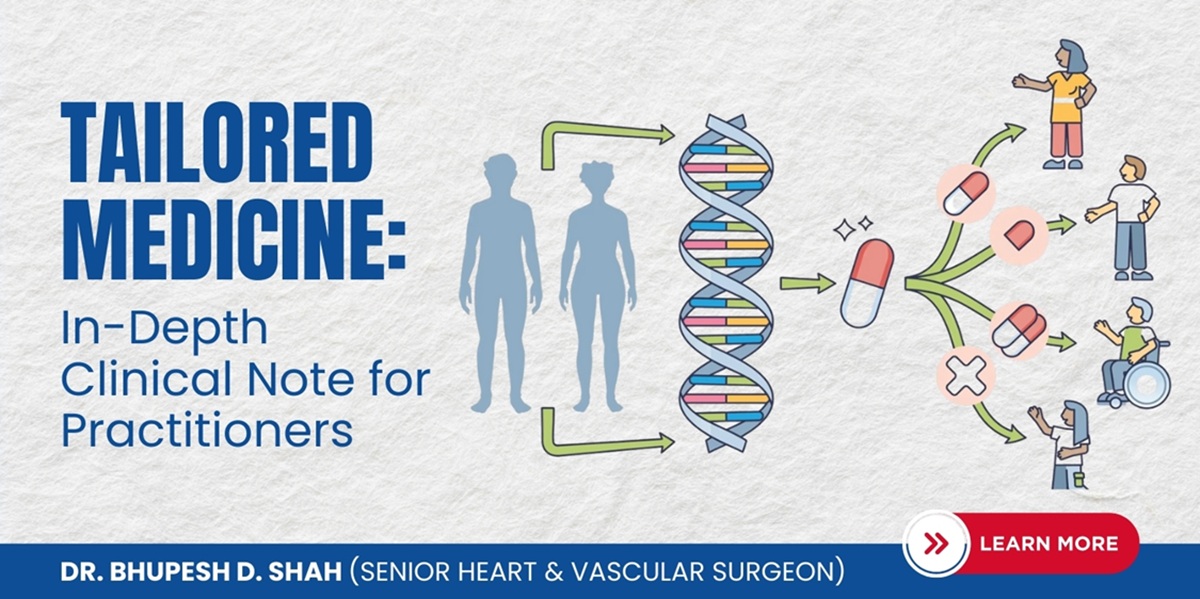
Tailored Medicine: In-Depth Clinical Note for Practitioners
- January 2, 2026
- Category :Clinical Notes
This note provides a detailed overview of Tailored Medicine (Precision Medicine), focusing on its clinical applications, implementation challenges, & the essential competencies required by modern medical practitioners.
Defining Tailored Medicine: Beyond the Average
Tailored Medicine is the strategic use of data-specifically molecular, environmental, and clinical data–to classify individuals into subpopulations that differ in their susceptibility to a particular disease, their prognosis, or their response to a specific treatment. It contrasts with traditional Evidence-Based Medicine (EBM), which relies on randomized controlled trials (RCTs) based on population averages. Tailored Medicine is data-driven EBM, leveraging high-throughput ‘omics’ technologies to enhance predictability and efficacy.
Core Data Sources for Actionable Insights:
- Genomics: Germline (inherited) and somatic (acquired, e.g., cancer) DNA mutations.
- Transcriptomics: Gene expression levels (RNA) indicating active disease pathways.
- Proteomics: Protein identification and quantification (drug targets and effectors).
- Metabolomics: Small molecule profiles reflecting real-time physiological status.
- Microbiome: Analysis of the gut and other microbial communities influencing drug metabolism and immune function.
Clinical Applications and Modalities
Tailored medicine is moving rapidly from research to routine clinical practice, primarily driven by advances in Pharmacogenomics (PGx) and Precision Oncology.
A. Pharmacogenomics (PGx): Mitigating ADRs and Optimizing Dosing
PGx analyzes the influence of genetic variation on drug response, focusing on two main categories of genes:
- Pharmacokinetic (PK) Genes: Encode enzymes responsible for drug metabolism (absorption, distribution, metabolism, excretion – ADME).
- Clinical Example: Variation in the Cytochrome P450 (CYP450) family, particularly CYP2D6 (metabolizes antidepressants, opioids) & CYP2C9/VKORC1 (warfarins), dictates metabolizer status (e.g., Ultra-Rapid, Extensive, Intermediate, Poor). This status mandates dose adjustment or alternative drug selection.
- Pharmacodynamic (PD) Genes: Encode drug targets (receptors, enzymes) or proteins in the disease pathway.
- Clinical Example: Testing for HLA-B*5701 before prescribing the HIV drug abacavir prevents a potentially fatal hypersensitivity reaction.
B. Precision Oncology: Targeting the Somatic Genome
Cancer treatment selection is increasingly dictated by the tumor’s genetic profile, not just its anatomical origin.
| Modality |
Description |
Clinical Example |
| Biomarker-Driven Therapy |
Targeting specific gene mutations or protein overexpression essential for tumor growth |
Trastuzumab use only in HER2-positive breast or gastric cancer |
| Basket Trials |
Clinical trials grouping patients by shared mutations regardless of tumor site |
Testing TRK inhibitors in cancers with NTRK fusion genes |
| Liquid Biopsy |
Monitoring recurrence and resistance via circulating tumor DNA (ctDNA) |
Detection of EGFR T790M mutation to switch to third-generation TKI |
Implementation Challenges for Clinical Adoption
Successful integration of tailored medicine requires systemic changes beyond access to testing.
- Data Interpretation and Complexity: Genomic reports often identify variants of unknown significance. Clinicians must differentiate actionable findings from background data, requiring training in clinical genetics and bioinformatics.
- Reimbursement and Access: High costs and fragmented coverage limit equitable access, raising ethical concerns.
- EHR Integration: Genomic data must be embedded into electronic health records with real-time clinical decision support at the point of prescribing.
- Longitudinal Data Management: Germline genetic data remains actionable throughout a patient’s lifetime and requires periodic reanalysis as new evidence emerges.
Practitioner Competencies: The Future Standard
The role of the medical practitioner is evolving from guideline application to data integration and risk communication.
Essential competencies include:
- Genomic Literacy: Understanding genetic terminology, inheritance patterns, and clinically relevant variants
- Informed Consent: Explaining implications of genetic testing, incidental findings, and family cascade testing
- Ethical Practice: Ensuring patient autonomy, data privacy, and awareness of legal protections such as GINA
- Collaboration: Working closely with genetic counselors, molecular pathologists, and clinical informaticists
- Lifelong Learning: Staying updated with evolving pharmacogenomic guidelines from bodies such as CPIC
Tailored medicine is no longer an adjunct to clinical care. It is rapidly becoming the precision infrastructure on which future standards of care will be built.