


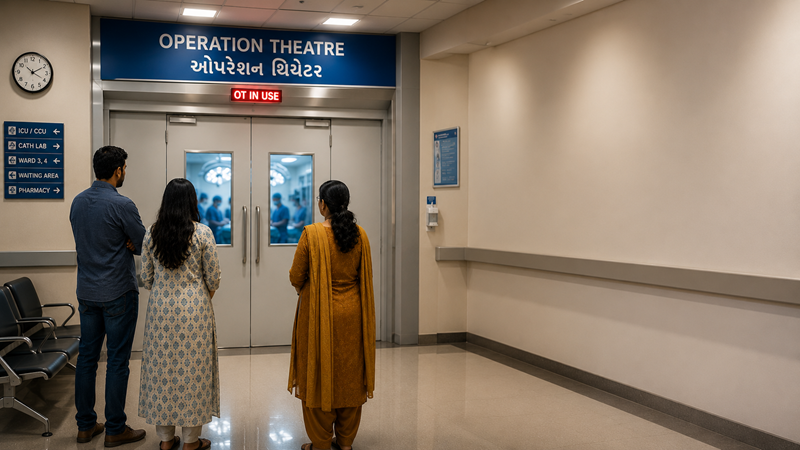
“The Operation Theatre Door Closed… And We Stood Outside.”
🫀 Heart to Heart — Episode 3
by Dr. Bhupesh D. Shah
That morning, at half past seven, a family stood outside the Operation Theatre.
The father — seventy years old.
He had gone in for bypass surgery.
His son, daughter-in-law, and daughter stood outside.
No one was talking.
No one had even touched their tea.
His son told me later,
“Doctor, those four to five hours were the heaviest hours of our lives. We had no idea what was happening inside. All we could see was that closed door.”
This is not just one family’s story.
Almost every family has stood outside an Operation Theatre at some point.
Waiting. Hoping. Not knowing.
And the biggest fear is always the same —
We don’t know what is happening inside.
So today, I want to take you inside the Operation Theatre.
To reduce the fear.
To increase the understanding.
🚪 The OT Door Closes — What Happens Next?
First — The Safety Checklist
Before any surgery begins, the entire team goes through the WHO Surgical Safety Checklist together.
The patient’s name, type of surgery, medications, allergies — everything is verified once again.
Nothing is left to chance.
This one step alone prevents countless errors before the surgery even begins.
Second — Anaesthesia
The patient is put into a deep, controlled sleep.
Muscles relax. Pain is completely blocked. The patient has no awareness of what is happening.
The anaesthetist stays with the patient throughout the entire surgery — monitoring every breath, every vital sign.
This is a highly safe and precisely controlled process.
Third — Monitoring
ECG, blood pressure, oxygen levels — watched every single second.
There is not just one doctor in the OT. There is an entire team.
Anaesthetist, nurses, technicians — each person focused on their specific role.
The patient is never alone. Not even for a moment.
Fourth — The Surgery
Bypass surgery can be performed in two ways.
In some cases, the heart is temporarily stopped and a Heart-Lung Machine takes over — maintaining blood flow throughout the body while the surgeon works.
In other cases, the surgery is performed on the beating heart itself — this is called Beating Heart Surgery or Off-Pump Bypass Surgery.
Both techniques are safe and have been proven successful over decades.
Which approach is used depends on the patient’s individual condition — and is decided by the surgeon after careful evaluation.
Fifth — The Team
It is not just the surgeon’s hands at work inside the OT.
An entire team is working together.
Every person trained.
Every person alert.
Every person there for one single purpose — to bring your loved one home, healthy and safe.
The surgery was successful.
When the Operation Theatre door opened, the son came to me.
“Doctor, how is my father?”
I said, “He is fine. The surgery went well.”
Those four words.
And he broke down completely.
Four to five hours of weight — lifted in one moment.
Fear of the OT is natural.
Fear of an unfamiliar place, an unfamiliar process — all of this is completely understandable.
But when understanding comes —
fear begins to fade.
The OT is not a place of fear.
The OT is a place of healing.
Every moment inside, every decision, every movement —
exists for one reason alone.
To bring your loved one back to you. ❤️🫀
If someone you know is scared of surgery right now — share this with them. Sometimes, understanding is the first step toward healing.
Dr. Bhupesh D. Shah
Heart Surgeon, Ahmedabad
Experience of 17000+ Cardiothoracic and Vascular Surgeries